
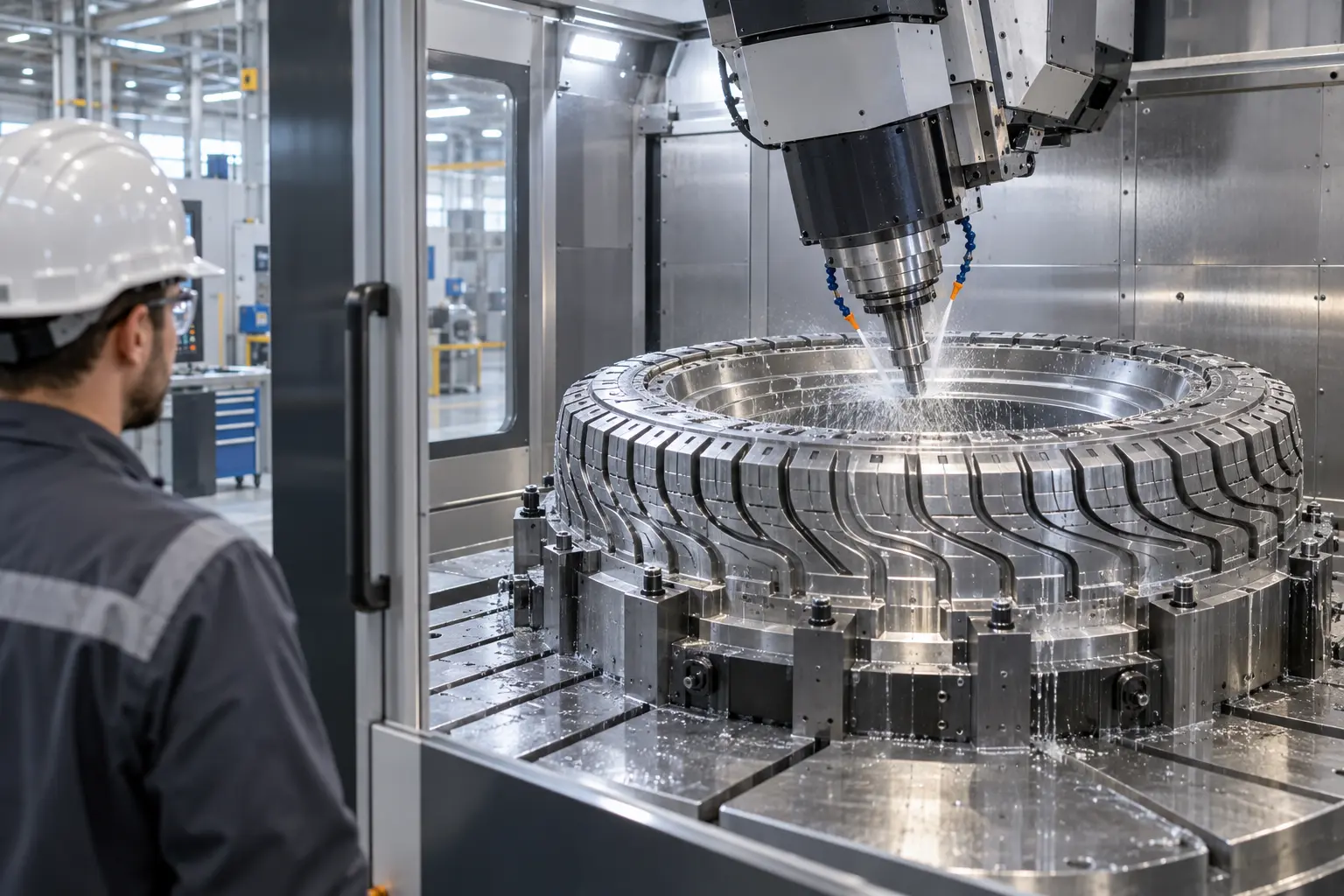
The tire mold manufacturing process converts tire design data into a precise curing tool that repeatedly forms tread geometry, sidewall markings and the final tire profile. Successful projects depend on disciplined data control, suitable materials, accurate machining and documented inspection at every stage.
Table of Contents
Tire Mold Manufacturing Process: 8 Steps at a GlanceThe tire mold manufacturing process begins with controlled customer data, including tire size, profile, tread model, pitch sequence, sidewall artwork, bead geometry, press interface and production requirements.
- Technical input review and project planning
- Tire mold design and manufacturability analysis
- Material selection and blank preparation
- Precision CNC rough and finish machining
- Tread detailing, sipes, lettering and venting
- Surface finishing and component fitting
- Assembly, dimensional inspection and functional checks
- Documentation, packing and delivery
1. Technical Input Review
The tire mold manufacturing process begins with controlled customer data, including tire size, profile, tread model, pitch sequence, sidewall artwork, bead geometry, press interface and production requirements.
2. Tire Mold Design and Engineering
Designers translate the tire model into mold cavity geometry and divide it into manufacturable components. For a segmented tire mold, this includes tread segments, sidewall plates, bead rings, inserts and interfaces with the mold container. The design should account for shrinkage strategy, split lines, tolerances, vent paths, drainage where required, engraving position, tooling access and maintenance.
3. Material Selection and Preparation
Material selection affects every later stage of the tire mold manufacturing process.Material choice affects heat transfer, machining time, durability, repairability and total cost. Aluminum alloys are often selected for cavity-forming parts, while steels may be used for structural, guiding or high-wear components. Incoming material should be traceable and checked before cutting. Blanks are prepared with sufficient allowance for stable roughing and finishing.
4. CNC Machining in the Tire Mold Manufacturing Process
Rough machining removes bulk material and establishes stable reference surfaces. Semi-finishing and finishing operations then create the cavity profile, segment joints, bead features and mounting interfaces. Three-axis, four-axis or five-axis CNC equipment may be used according to component geometry. Process planning should control tool access, cutter deflection, thermal effects and consistent datums between setups.
5. Tread Detailing, Engraving and Venting
Fine tread features can require small-tool machining, electrical discharge machining, laser processing or purpose-built inserts, depending on the design and material. Sidewall lettering, logos and regulatory markings must remain legible and correctly oriented. Vent holes or alternative venting solutions are positioned to evacuate trapped air without creating unacceptable rubber flash. These details have a direct effect on finished tire appearance.This stage of the tire mold manufacturing process directly affects tread definition, air release and the appearance of the finished tire.
6. Finishing, Fitting and Assembly
After machining, components are deburred, cleaned and finished to the specified surface condition. Technicians fit inserts, vents and hardware, then assemble matched segments and sidewall components. Split lines and transitions are reviewed carefully because local mismatch can transfer directly to the cured tire.
7. Inspection and Functional Verification
Inspection is one of the most important stages in the tire mold manufacturing process.
Inspection should follow a documented plan based on critical product and interface characteristics. Depending on the project, verification may include coordinate measurement, profile scanning, runout checks, surface inspection, engraving review, vent confirmation and opening/closing tests. Results should be compared with the approved drawing or 3D dataset, not an uncontrolled intermediate file.
| Control point | Typical verification | Why it matters |
|---|---|---|
| Cavity profile | CMM or scanning against CAD | Supports dimensional consistency of the cured tire |
| Segment matching | Assembly inspection and joint review | Reduces visible mismatch and flash |
| Press interface | Datum, mounting and fit checks | Prevents installation delays |
| Venting | Position, quantity and continuity check | Helps avoid trapped-air defects |
| Markings | Artwork and orientation review | Protects brand and regulatory accuracy |
8. Documentation, Packing and Delivery
A complete delivery package may include inspection reports, material documentation, assembly records, spare-parts information, maintenance guidance and approved drawings. Mold surfaces need protection against impact, moisture and contamination during transport. Clear lifting and handling instructions reduce risk when the tooling reaches the customer plant.
Completing the tire mold manufacturing process with accurate documentation also makes future maintenance and replacement easier.
How to Evaluate Tire Mold Manufacturers
- Engineering capability: can the team identify manufacturability, venting and press-interface risks before production?
- Process coverage: are critical machining, engraving, inspection and assembly operations controlled in-house?
- Quality evidence: can the manufacturer provide traceable inspection results for critical features?
- Change control: is there a clear system for design revisions and customer approvals?
- After-sales response: can the supplier support repair, modification, cleaning and spare components?
For additional industry context, the U.S. Tire Manufacturers Association explains how a green tire is shaped and cured inside a mold. This curing stage shows why cavity accuracy, venting and thermal control are essential throughout the tire mold manufacturing process.
Frequently Asked Questions
How long does tire mold manufacturing take?
Lead time depends on mold size, complexity, data readiness, material availability, finishing requirements and validation scope. A supplier should provide a milestone schedule after reviewing complete technical inputs.
Why is data revision control important?
Tread, profile or sidewall changes can affect many components. Manufacturing from an obsolete file can cause costly rework, so every approval and revision should be traceable.
Can one mold produce different sidewall versions?
Many designs can use replaceable sidewall lettering or inserts, but feasibility depends on the mold architecture, marking location and customer requirements. This should be planned during the design stage.
Need a Reliable Tire Mold Manufacturing Partner?
Share your tire size, tread model, sidewall artwork and curing equipment information to start a technical review and quotation.