
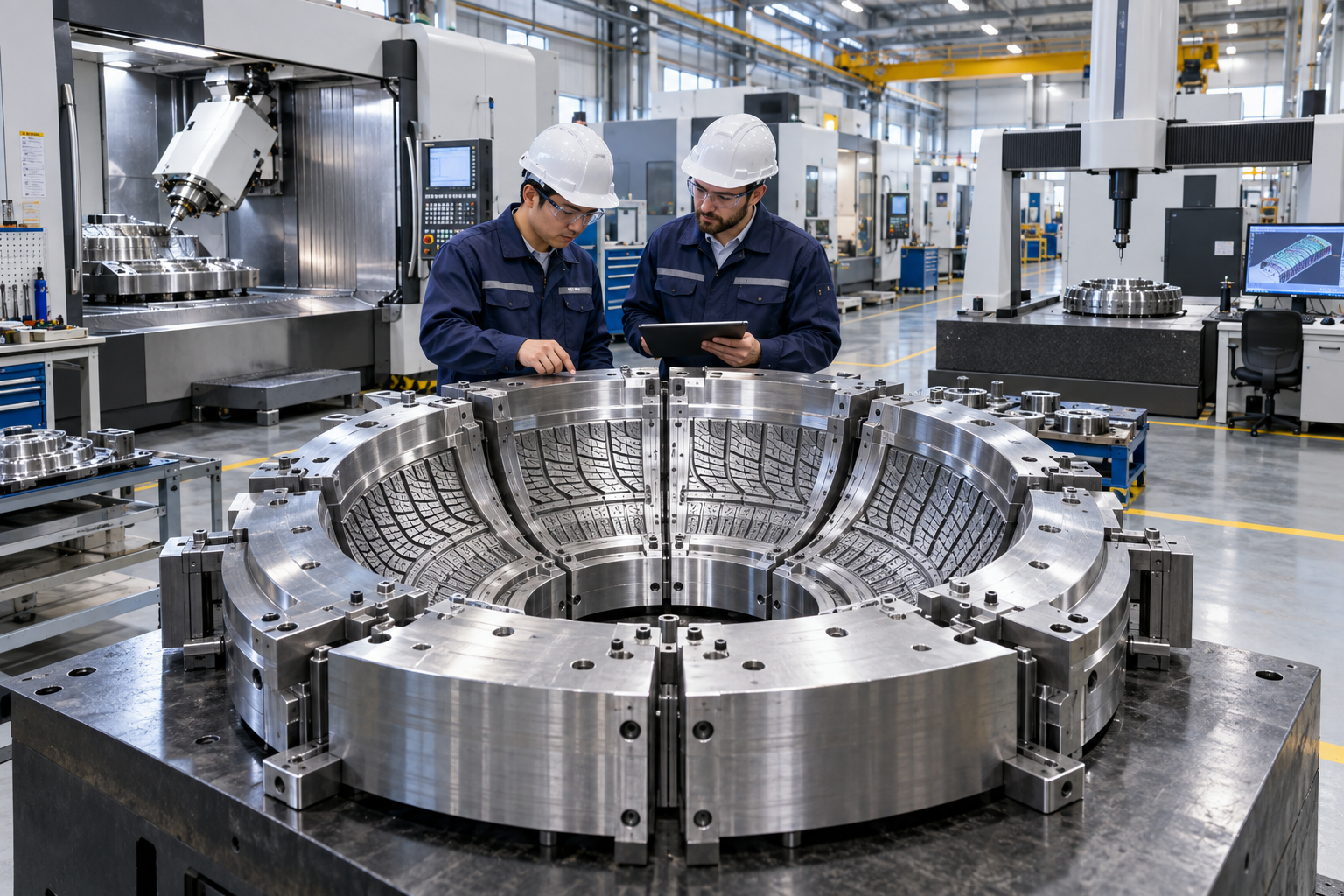
Choosing between different tire mold manufacturers requires more than comparing quotations. A lower initial price may not represent a lower total cost if the mold requires repeated modification, creates curing defects or arrives without reliable inspection records.
Qualified suppliers should demonstrate engineering knowledge, controlled manufacturing, accurate inspection and dependable after-sales support.
This guide provides ten practical checks for evaluating tire mold manufacturers before placing an order.
Table of Contents
- Industry Experience
- Engineering Capability
- Manufacturing Equipment
- Process Control
- Quality Management
- Inspection Capability
- Material Traceability
- Delivery Management
- After-Sales Support
- Communication and Documentation
1. Relevant Tire Mold Experience
Begin by checking whether the supplier has experience with your tire category and mold structure.
Some tire mold manufacturers focus on passenger-car molds, while others may have stronger capabilities in truck, agricultural, motorcycle, industrial or off-the-road tire molds.
Ask potential suppliers for information about:
- Tire categories previously produced
- Mold sizes and structures
- Segmented and two-piece mold experience
- Curing press compatibility
- Similar tread complexity
- Export and international project experience
A supplier that understands your application can identify technical risks earlier in the project.
2. Engineering and Design Capability
Manufacturing equipment alone does not guarantee a successful mold. Engineering capability determines whether customer data can be converted into a reliable and maintainable production tool.
Experienced tire mold manufacturers should be able to review:
- Tire profile data
- Tread geometry
- Pitch sequence
- Sidewall artwork
- Segment division
- Venting requirements
- Press and container interfaces
- Machining accessibility
The engineering team should explain potential problems before production rather than simply machining the files provided by the customer.
Ask how design revisions are recorded, approved and released to manufacturing.
3. In-House Manufacturing Equipment
The supplier’s equipment should match the size, geometry and accuracy requirements of the project.
Relevant capabilities may include:
- Three-axis and five-axis CNC machining
- Turning and milling
- Electrical discharge machining
- Laser engraving or texturing
- Small-tool tread machining
- Surface finishing
- Mold assembly
- Coordinate measurement and scanning
Ask which processes are performed in-house and which are outsourced. Excessive outsourcing can make quality control, scheduling and problem resolution more difficult.
Professional tire mold manufacturers should understand the limitations of each process and select suitable methods for different mold features.
4. Manufacturing Process Control
Consistent results depend on process control, not only operator experience.
The supplier should have defined procedures for material inspection, blank preparation, rough machining, stress control, finish machining, engraving, venting, deburring, cleaning and assembly.
Important questions include:
- How are machining datums maintained?
- How are matched mold segments controlled?
- How is tool wear monitored?
- How are drawings and CNC programs linked to approved revisions?
- How are nonconforming components identified?
- How is rework documented?
Clear answers indicate that production is managed systematically.
5. Quality Management System
When comparing tire mold manufacturers, review how each company manages quality responsibilities, records, corrective action and continuous improvement.
A quality-management certificate may be useful, but the actual system is more important than the certificate alone.
Look for evidence such as:
- Incoming material inspection
- In-process inspection plans
- Final inspection reports
- Measuring-equipment calibration
- Nonconformance records
- Corrective-action procedures
- Drawing revision control
- Employee training records
The current ISO 9001 quality-management standard provides an internationally recognized framework for managing consistent processes and customer requirements.
6. Dimensional Inspection Capability
A supplier should be able to verify the features that affect mold installation and finished tire quality.
Depending on the project, inspection equipment may include coordinate measuring machines, profile scanners, height gauges, micrometers and dedicated fixtures.
Ask tire mold manufacturers how they inspect:
- Cavity profile
- Segment pitch
- Radial runout
- Split-line alignment
- Sidewall orientation
- Bead-ring dimensions
- Mounting interfaces
- Engraving accuracy
The inspection method should correspond with the specified tolerance. A measurement report is only useful when the datum, method and acceptance criteria are clear.
7. Material Certification and Traceability
Mold materials affect heat transfer, strength, wear resistance, machinability and service life.
Suppliers should identify the selected aluminum alloy, steel grade or insert material and explain why it is appropriate for the application.
Material certificates should be connected to the actual components used in the project. Traceability becomes especially important when customers order replacement segments, inserts or repair parts later.
Avoid choosing tire mold manufacturers that cannot clearly explain their material sources and incoming inspection process.
8. Project Schedule and Delivery Control
A reliable quotation should contain more than a total lead time. It should show important project milestones.
Typical milestones include:
- Customer data review
- Design confirmation
- Material preparation
- Rough machining
- Finish machining and detailing
- Assembly
- Final inspection
- Packing and shipment
Ask how the supplier reports delays and manages customer design changes.
The shortest promised lead time is not always the safest option. A realistic schedule supported by clear milestones is more valuable than an aggressive date without process planning.
9. Repair and After-Sales Support
Molds may require cleaning, vent replacement, engraving changes, insert replacement or repair during their service life.
Before ordering, ask whether the supplier can provide:
- Spare vents and inserts
- Replacement mold segments
- Sidewall marking modifications
- Damage assessment
- Repair machining
- Maintenance instructions
- Remote technical assistance
- On-site support when necessary
Responsive after-sales service can reduce downtime and extend tooling life.
Tire mold manufacturers should also retain controlled project data so future replacement components match the original mold.
10. Communication and Technical Documentation
International tooling projects require accurate communication between engineering, purchasing, production and quality teams.
A reliable supplier should confirm technical questions in writing and maintain a clear list of open items.
The final documentation package may include:
- Approved drawings
- 3D-data revision records
- Material certificates
- Inspection reports
- Assembly information
- Spare-parts lists
- Maintenance recommendations
- Packing records
Good documentation makes installation, acceptance and future service easier.
Warning Signs When Comparing Suppliers
Be cautious when a supplier:
- Provides a quotation without reviewing technical data
- Cannot explain its design or inspection process
- Refuses to identify outsourced operations
- Offers no material certificates
- Cannot provide dimensional reports
- Uses unclear revision-control methods
- Promises an unrealistic delivery date
- Has no plan for replacement parts or repairs
- Competes only on price
A technically detailed quotation is usually more reliable than a short quotation containing only price and delivery time.
Frequently Asked Questions
What should I send tire mold manufacturers for a quotation?
Provide the tire size, profile drawing, tread data, sidewall artwork, pitch sequence, press information, mold quantity, venting preference and expected delivery date.
Should I choose the lowest-priced supplier?
Not automatically. Compare engineering support, inspection capability, material quality, delivery reliability and after-sales service. These factors affect the total cost of the mold.
How can I verify a manufacturer’s quality capability?
Request sample inspection reports, equipment lists, material certificates, process-control information and evidence from comparable projects.
Why is press compatibility important?
The mold must fit the customer’s curing press and container. Incorrect interfaces can create installation delays, additional machining and production downtime.
Can tire mold manufacturers supply replacement components?
Many manufacturers can provide replacement segments, inserts, bead rings and other components. Confirm data-retention and replacement-part policies before ordering.
Request a Tire Mold Supplier Evaluation
Send your tire specifications, tread data, curing press information and required delivery schedule for a technical review. A detailed project evaluation makes it easier to compare tire mold manufacturers on engineering value, quality and long-term support—not price alone.