
Choosing the right tire mold is an important part of maintaining stable tire production.
For tire manufacturers, one common challenge is keeping tread details, mold dimensions, and batch quality consistent during repeated production. If mold accuracy, fitting, or structure is unstable, it can affect tread forming and create additional adjustment work during production.
Qingdao Pinjin Precision Mold manufactures tire molds for passenger car, truck and bus, motorcycle, bicycle, agricultural, OTR, ATV, and solid tire applications. Its manufacturing capabilities include CNC machining, EDM engraving, heat treatment, mold assembly, and quality inspection. pj.tydzg.cn
When evaluating a tire mold, three factors deserve particular attention: machining precision, quality control throughout production, and customization for different tire requirements.
1. High-Precision Tire Mold Machining Helps Maintain Consistent Tread Forming
The first factor is machining accuracy.
A tire mold contains detailed tread structures, sidewall features, fitting surfaces, and other precision areas. These details need to remain accurate if the mold is expected to deliver repeatable results during tire production.
According to Pinjin, its production capability includes CNC machining, and its key CNC machining accuracy can reach ±0.005 mm depending on the mold structure. pj.tydzg.cn
High-precision machining is especially important for tread definition and segment fitting.
Pinjin states that accurate machining directly influences tread definition, segment fitting, and production consistency. Its equipment includes advanced machining capabilities designed to maintain accurate mold dimensions and consistent quality. pj.tydzg.cn
For tire manufacturers, this can help address an important production concern: reducing variation between molds and keeping tire forming more consistent from one production cycle to another.
Pinjin provides tire mold solutions for different applications, including passenger car, motorcycle, bicycle, agricultural, OTR, ATV, and solid tires. Each category has different tread structures and production requirements, making machining precision an important part of mold manufacturing. pj.tydzg.cn
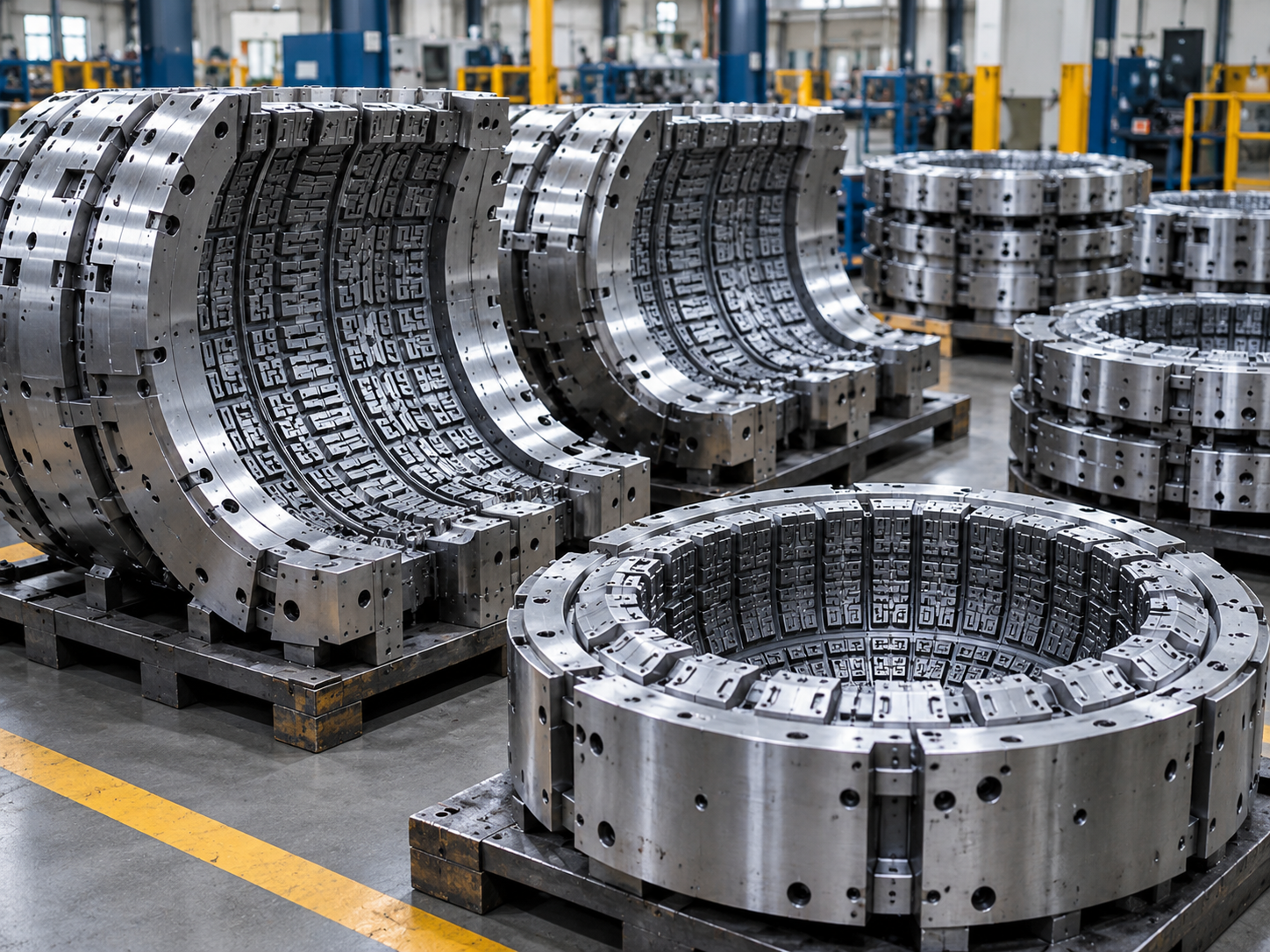
Suggested image position: Insert a close-up image of CNC machining or a finished tire mold tread cavity here.
2. Quality Control Throughout Tire Mold Production Supports Stable Performance
Precision machining alone is not enough.
A reliable tire mold also depends on how quality is controlled during the complete manufacturing process.
Pinjin states that inspection is integrated throughout machining, fitting, and assembly. Its manufacturing capabilities also include EDM engraving, heat treatment, mold assembly, and strict quality inspection. pj.tydzg.cn
This is important because tire mold manufacturing involves multiple production stages.
A mold may be accurately machined, but fitting, assembly, surface condition, or other details can still affect final performance if they are not checked carefully.
For manufacturers purchasing molds for repeated tire production, stable quality control can help reduce uncertainty before a mold enters production.
Pinjin also states that materials are selected according to mold structure and production requirements, including forged medium-carbon steel and other qualified mold steels. The company says qualified forged steel is selected according to mold structure, service-life requirements, and curing requirements. pj.tydzg.cn
The key point is not simply using one standard material for every application. Different tire molds can have different structures and production conditions, so material selection and manufacturing processes need to match the specific project.
This is particularly relevant for manufacturers producing different tire categories, from smaller bicycle and motorcycle tires to agricultural and large OTR tires.
3. Custom Tire Mold Engineering Helps Match Different Production Requirements
The third factor is customization.
There is no single tire mold structure that fits every tire product.
Passenger car tires, OTR tires, agricultural tires, motorcycle tires, and solid tires can require different tread designs, dimensions, mold structures, and production specifications.
Pinjin provides custom engineering solutions developed around customer tire designs and production requirements. The company supports custom tread, sidewall, venting, and mold structure design based on customer drawings and specifications. pj.tydzg.cn
Custom tread patterns and sidewall markings can also be developed from customer technical data. pj.tydzg.cn
This is important for tire manufacturers developing new products or working with multiple tire specifications.
For example, Pinjin describes its passenger car tire molds as precision solutions for stable tread forming and curing, while its OTR molds are designed for mining, earthmoving, and other demanding off-road applications. Agricultural tire molds are designed around deep lugs, traction patterns, and heavy-duty production. pj.tydzg.cn
These differences show why tire mold selection should be based on the actual tire design and production requirement rather than choosing a general-purpose solution.
Pinjin also provides support from design review through finished mold and after-sales technical assistance, which can help manufacturers coordinate technical requirements throughout the project.
A reliable tire mold should support consistent production rather than create additional adjustment work.
For tire manufacturers concerned about tread consistency, mold accuracy, and production stability, three areas are especially important: precise machining, quality control throughout manufacturing, and engineering customization based on the actual tire specification.
Qingdao Pinjin Precision Mold provides tire mold solutions for passenger car, truck and bus, motorcycle, bicycle, agricultural, OTR, ATV, and solid tire applications. Its manufacturing capabilities include CNC machining, EDM engraving, heat treatment, mold assembly, and quality inspection. pj.tydzg.cn
When selecting a tire mold supplier, manufacturers can therefore focus on whether the supplier can accurately manufacture the required design, control quality throughout production, and adapt the mold to the specific tire application.
For a custom tire mold project, technical drawings, tread requirements, tire specifications, and production requirements can be reviewed before the manufacturing schedule is confirmed.
For additional technical information about tire dimensions, performance, and standardization, manufacturers can also refer to the ISO Technical Committee for Tyres, Rims and Valves.