
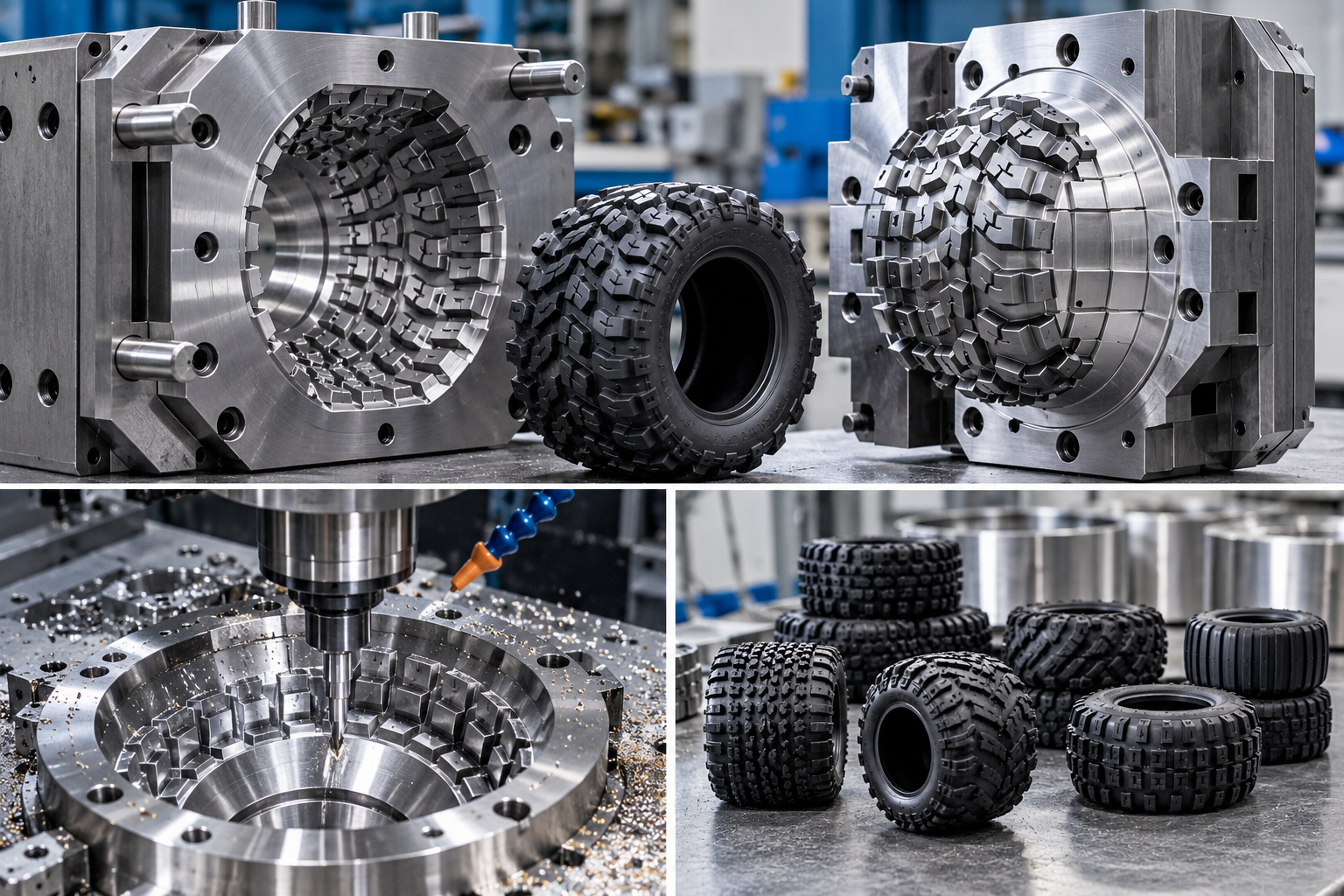
RC tire manufacturers and aftermarket tire brands often face a practical challenge: one tire design cannot meet every racing condition. A tread pattern intended for loose dirt may not be suitable for a smooth asphalt track, while a tire designed for off-road use may require different tread blocks and shoulder details from an on-road racing tire.
For companies developing several tire models, the RC car tire mold becomes an important part of turning these different designs into manufacturable products.
The challenge is not simply making a smaller tire mold. Each new tread pattern, tire profile, or sidewall design introduces technical requirements that need to be reviewed before manufacturing.
A suitable RC car tire mold should reflect the intended racing application, reproduce small tread features accurately, and support the manufacturer’s product development plans.
This article examines three common challenges in RC tire development and explains what buyers should consider when evaluating a custom tire mold project.
1. Match the RC Car Tire Mold to Different Racing Surfaces
RC vehicles operate on different surfaces, including asphalt, carpet, loose dirt, clay, gravel, and prepared off-road tracks.
These environments can require different tire tread designs. For example, a tire intended for smooth pavement may use a relatively simple tread profile, while an off-road tire may feature more prominent blocks, grooves, and shoulder details.
For an RC tire manufacturer, the first challenge is translating these application requirements into a practical mold design.
A tread pattern may look attractive in a product drawing, but the manufacturer still needs to determine whether the details can be accurately produced in the mold cavity.
Important design considerations include:
- Tire diameter and width
- Tread block arrangement
- Groove depth and spacing
- Tire shoulder geometry
- Sidewall profile and markings
- Mold cavity structure
An RC car tire mold should therefore be developed around the intended tire geometry rather than assuming that the same mold structure will suit every racing application.
Qingdao Pinjin Precision Mold provides custom tire mold engineering based on customer drawings and specifications. Its stated capabilities include custom tread, sidewall, venting, and mold structure design.
Although RC car tire molds are not listed as a separate standard product category, these engineering capabilities provide a basis for discussing the technical feasibility of a custom project.
For buyers, the practical starting point is to provide accurate tire specifications and clearly identify the intended application.
2. Preserve Small Tread and Sidewall Details in an RC Car Tire Mold
Small tire dimensions can make mold manufacturing more demanding.
On a full-size tire, a tread feature may have enough space for conventional machining approaches. On a much smaller RC tire, similar design details may need to be reproduced within a more compact cavity.
This creates several potential difficulties.
Narrow grooves may be difficult to machine. Small tread blocks may require careful tool selection. Sidewall lettering and branding details need to remain clear without interfering with nearby features.
These challenges become especially relevant for RC tire brands offering different tread styles or customized sidewall designs.
An RC car tire mold project should therefore include a review of which features can be manufactured reliably and which may need design adjustments.
Why machining capability matters
Pinjin’s stated manufacturing capabilities include CNC machining, EDM engraving, heat treatment, mold assembly, and quality inspection.
The company reports that key CNC machining accuracy can reach ±0.005 mm, depending on the mold structure.
This figure describes a machining capability, not a guaranteed tolerance for every custom RC tire mold.
The achievable accuracy of an individual project would need to be confirmed after reviewing the dimensions, material, cavity geometry, and technical drawings.
For RC tire manufacturers, the most useful questions are practical:
Can the required tread grooves be machined?
Can the sidewall markings be reproduced at the specified size?
Can the mold components be manufactured and fitted according to the approved design?
Are there any details that should be simplified before production?
Reviewing these questions early can help avoid manufacturing a mold that does not accurately represent the intended tire design.
3. Plan RC Car Tire Mold Projects for Multiple Tire Models and Small Batches
RC tire brands may develop several models for different racing conditions, vehicle types, or customer preferences.
Unlike a manufacturer producing only one tire specification, these businesses may need to manage multiple tread patterns, sizes, and design revisions.
This creates a purchasing challenge.
Ordering a custom RC car tire mold without a clear product plan can lead to unnecessary design changes, duplicated engineering work, or delays when the next tire model is introduced.
A better approach is to organize the project around the manufacturer’s actual product range.
For example, a tire brand developing on-road and off-road products could prepare separate technical specifications for each design. Each specification should identify the tire dimensions, tread geometry, sidewall artwork, and relevant manufacturing requirements.
The mold manufacturer can then evaluate each design independently.
This does not mean that one mold can automatically manufacture several different tire models. Whether any mold components can be shared or modified depends on the specific structure and engineering requirements.
Why future maintenance should also be considered
Custom mold purchasing should also account for maintenance and replacement needs.
Pinjin provides tire mold component manufacturing and repair support. Its component range includes tread segments, sidewall plates, mold rings, inserts, and venting components.
The company states that components can be manufactured according to customer drawings, existing mold structures, or specific technical requirements.
For an RC tire project, buyers can discuss whether the proposed mold structure allows practical maintenance or replacement of individual components.
The suitability of these options must be confirmed during engineering review.
For small-batch tire brands, this planning can be more valuable than selecting a mold solely on its initial quotation.
What Information Should You Provide for an RC Car Tire Mold Quotation?
Before contacting a tire mold manufacturer, prepare a clear technical package.
| Required information | Why it matters |
|---|---|
| Tire diameter and width | Defines basic mold dimensions |
| Tire profile | Helps establish cavity geometry |
| Tread pattern drawing | Identifies grooves, blocks, and other features |
| Sidewall artwork | Defines branding and lettering requirements |
| 2D or 3D technical files | Supports engineering and manufacturing review |
| Intended tire application | Provides context for design requirements |
| Production requirements | Helps evaluate mold structure and project scope |
| Expected quantity and schedule | Supports quotation and production planning |
Complete technical information allows the supplier to evaluate the project more accurately.
It is also important to confirm the approved design version before manufacturing begins. Changes to tread geometry, tire dimensions, or sidewall artwork after machining starts may require additional engineering work.
For more information about Pinjin’s general machining and component capabilities, see its Tire Mold Components page.
Conclusion: Choose an RC Car Tire Mold Based on the Actual Tire Application
Developing RC tires for different racing surfaces involves more than choosing an attractive tread pattern.
The mold must accurately represent the intended tire geometry while remaining practical to manufacture.
For RC tire brands and manufacturers, three considerations are particularly important.
First, define the racing application and tire design before selecting the mold structure.
Second, review small tread features, grooves, and sidewall markings to determine whether they can be manufactured accurately.
Third, organize custom mold projects around the product range, expected production requirements, and future maintenance needs.
Qingdao Pinjin Precision Mold manufactures tire molds for applications including bicycle, motorcycle, passenger car, ATV, agricultural, and other tire categories. The company also provides custom engineering, precision machining, and tire mold component services.
For a specialized RC car tire mold project, customers should submit their technical drawings and production requirements for an engineering feasibility review. Project suitability, manufacturing scope, and delivery schedule should be confirmed before an order is placed.
For additional technical information about tire design and manufacturing standards, you can refer to the ISO Technical Committee for Tyres, Rims and Valves, which covers international standardization related to tires, rims, and valves.