
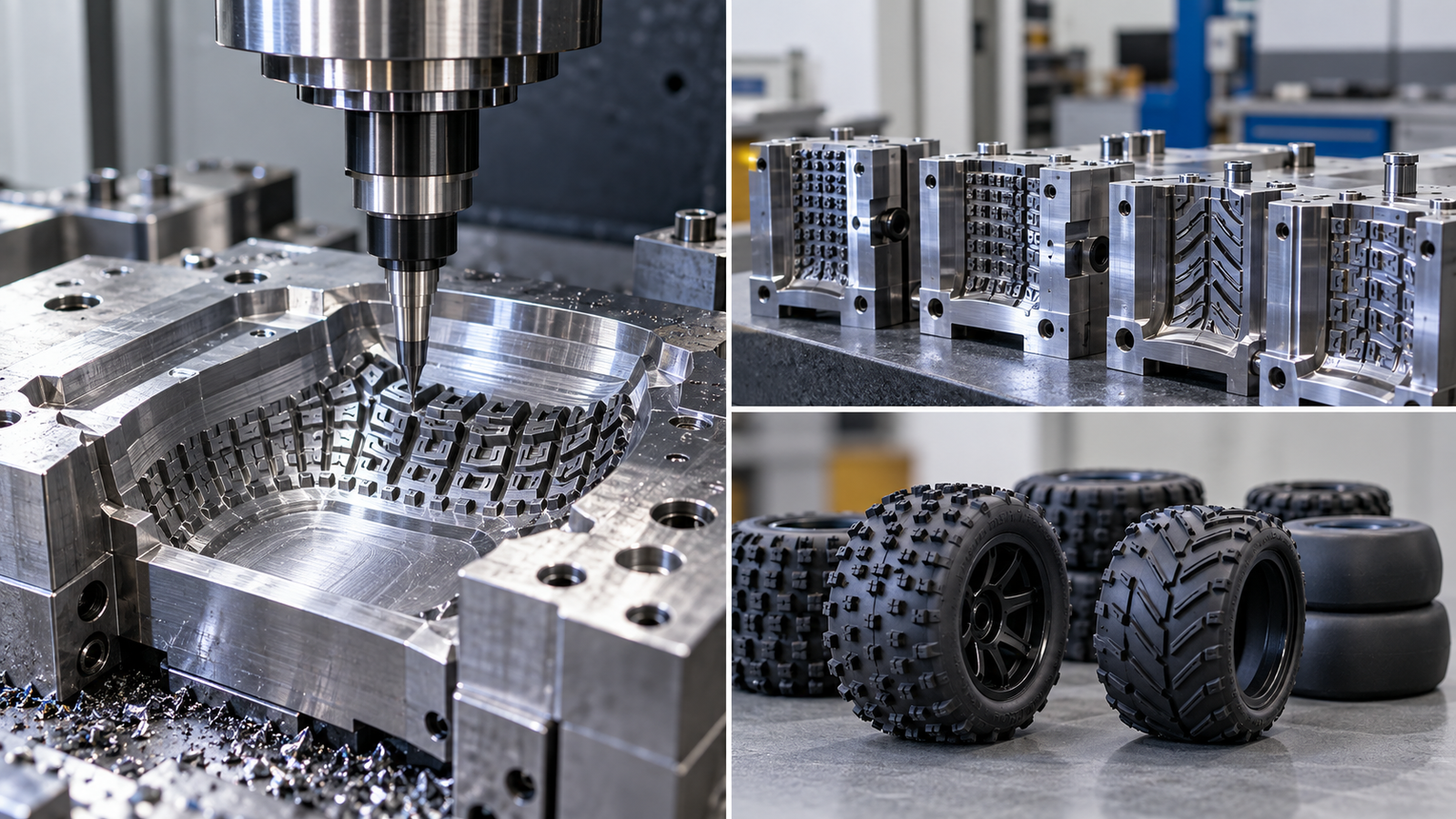
For manufacturers developing small rubber tires, one of the biggest challenges is reproducing fine tread details consistently on a relatively small tire surface.
An RC car tire mold may be smaller than a passenger-car or commercial tire mold, but that does not make the manufacturing process simple. Small tread blocks, narrow grooves, sidewall details, and dimensional consistency all depend on accurate mold design and machining.
Qingdao Pinjin Precision Mold does not currently list RC car tire molds as a separate standard product category on its website. However, the company manufactures custom tire molds for motorcycle, bicycle, passenger-car, agricultural, OTR, ATV, and solid-tire applications, and supports custom tread, sidewall, venting, and mold-structure design based on customer drawings and specifications. pj.tydzg.cn
For buyers considering a custom RC car tire mold project, three areas deserve particular attention: fine-detail machining, customization from technical data, and mold consistency for repeat production.
1. Fine Machining Is Critical for Small RC Car Tire Mold Details
The smaller the tire, the more noticeable small dimensional differences can become.
An RC car tire mold can contain relatively narrow tread grooves, small tread blocks, detailed shoulder patterns, and compact sidewall markings. If these features are not machined accurately, the finished tire may not reproduce the intended tread design clearly.
This makes machining capability particularly important when evaluating a tire mold manufacturer.
Pinjin states that its manufacturing capabilities include CNC machining and precision EDM engraving. According to its website, key CNC machining accuracy can reach ±0.005 mm, depending on mold structure. pj.tydzg.cn
For a small-size tire mold project, this type of precision capability is relevant because many mold features are concentrated within a much smaller area.
The objective is not simply to create the general shape of a tire. The mold needs to reproduce the designed tread geometry repeatedly and maintain accurate relationships between individual mold features.
Pinjin also notes that accurate machining affects tread definition, component fitting, and production consistency. pj.tydzg.cn
For an RC car tire mold, buyers should therefore pay particular attention to how the manufacturer handles detailed tread machining rather than evaluating the mold only by its overall dimensions.
2. Custom Engineering Matters When the Tire Design Is Not Standard
RC tires can vary significantly in tread appearance and intended design.
For this reason, an RC car tire mold project may need to be developed around the customer’s own tire dimensions, tread data, sidewall design, and mold requirements rather than selected from a standard mold specification.
Pinjin states that every custom mold can be developed around customer tire designs and production requirements. The company supports custom tread patterns, sidewall markings, venting, and mold structures based on customer drawings and technical specifications. pj.tydzg.cn
This is especially relevant when developing a new small tire product.
Before machining begins, the buyer and mold manufacturer should make sure that the technical information being used is clearly defined.
Depending on the project, this may include:
- Tire dimensions
- Tread drawings or 3D data
- Sidewall design
- Mold structure requirements
- Venting requirements
- Production quantity
- Other manufacturing specifications
Pinjin’s segmented tire mold guidance similarly recommends confirming tire size, profile information, tread data, sidewall artwork, production requirements, and other technical inputs before machining begins. pj.tydzg.cn
For an RC car tire mold, this engineering stage can be particularly important because small changes in tread geometry or dimensions may require corresponding changes to the mold.
A clear technical review before production can reduce the risk of discovering design problems after machining has already started.
3. Consistent Mold Manufacturing Supports Repeat Tire Production
A prototype tire that looks correct once is not enough for a commercial manufacturing project.
The mold needs to support repeat production.
For buyers sourcing an RC car tire mold, consistency between machining, fitting, inspection, and assembly can therefore be just as important as the initial tread design.
Pinjin states that its quality-control system includes inspection throughout machining, fitting, and assembly. Its manufacturing capabilities also include CNC machining, EDM engraving, heat treatment, mold assembly, and quality inspection. pj.tydzg.cn
The company also provides precision tire mold components for mold production, maintenance, repair, and replacement projects. These components can be manufactured according to customer drawings, existing mold structures, or specific technical requirements. pj.tydzg.cn
For small tire manufacturers, this is relevant because mold performance is influenced by more than the visible tread cavity.
Accurate fitting between mold components, consistent dimensions, surface condition, and correct assembly can all affect how reliably the mold performs during repeated production.
Pinjin’s website states that materials are selected according to mold structure and production requirements rather than using one identical material specification for every mold project. pj.tydzg.cn
This is an important consideration for a custom RC car tire mold project. The appropriate mold structure and manufacturing solution should be determined according to the actual tire design and production conditions.
Instead of purchasing a mold based only on price, buyers can review whether the supplier has the machining, inspection, and engineering capabilities required for repeated production.
Conclusion
An RC car tire mold is a small-size tooling project, but it can still require a high level of manufacturing accuracy.
For buyers developing RC tires, three areas are particularly important: precise machining of small tread details, custom engineering based on actual tire data, and consistent manufacturing and inspection for repeat production.
Pinjin does not currently present RC car tire molds as a dedicated standard product category. However, its existing capabilities include custom tire mold engineering, CNC machining, EDM engraving, mold assembly, precision inspection, and production of tire molds and components across multiple tire categories. pj.tydzg.cn
For a custom RC car tire mold project, the most practical starting point is to provide the tire dimensions, tread design, drawings or 3D data, sidewall information, and production requirements for engineering review before mold manufacturing begins.
For additional information about tire and rim standards, manufacturers can refer to the ISO Technical Committee for Tyres, Rims and Valves.