
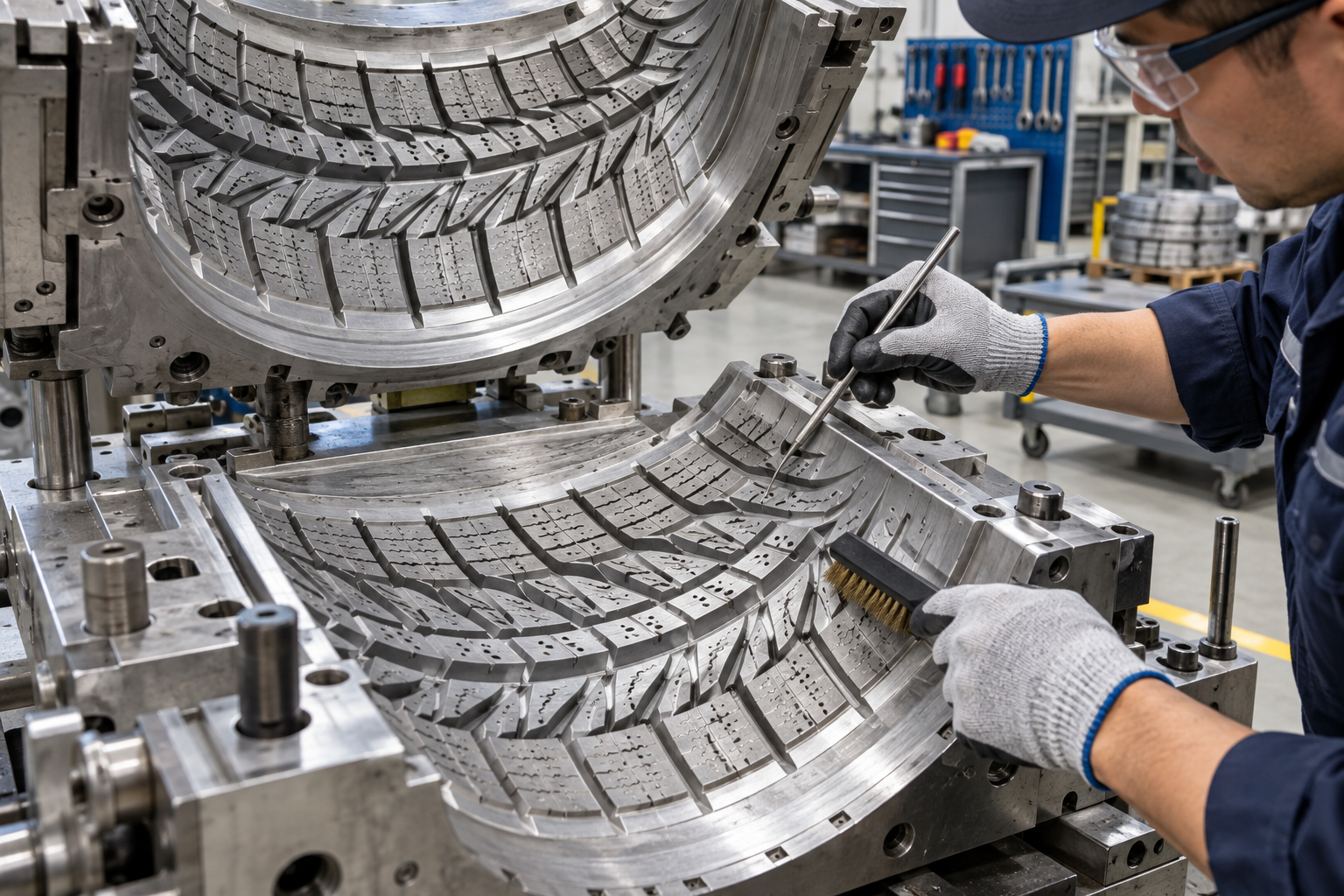
Regular tire mold maintenance protects tread accuracy, venting performance and production stability. Without proper cleaning and inspection, rubber residue, release agents and corrosion can gradually affect the mold cavity.
A planned tire mold maintenance program helps tire manufacturers reduce unexpected downtime, prevent recurring defects and extend tooling service life. The following nine practices can be adapted to different tire types and production conditions.
Table of Contents
1. Establish a Tire Mold Maintenance Schedule
Maintenance frequency should be based on curing cycles, rubber compounds, venting condition and observed tire quality.
A tire mold used continuously may require more frequent inspection than tooling used for short production runs. Maintenance should also be scheduled when operators observe incomplete filling, excessive flash, unclear lettering or difficult demolding.
A practical schedule can include:
- Daily visual inspection
- Routine cavity cleaning
- Vent inspection after a defined number of cycles
- Periodic dimensional checks
- Major inspection during production changeovers
Clear responsibilities help ensure that maintenance is completed consistently.
2. Clean the Mold Cavity Correctly
Proper tire mold maintenance requires a cleaning method that removes contamination without changing the cavity surface.
Rubber residue and release agents can accumulate on tread blocks, grooves and sidewall engravings. The cleaning method should remove contamination without changing the mold surface.
Avoid aggressive tools that may scratch precision surfaces or round sharp tread details. Cleaning parameters should match the mold material, coating and contamination level.
After cleaning, technicians should inspect the complete cavity under suitable lighting.
To understand how tooling quality begins before maintenance, read our Tire Mold Manufacturing Process guide.
3. Inspect and Clean Vent Holes
Vent inspection is an essential part of tire mold maintenance because blocked vents can directly affect tread filling.
Blocked vents can trap air between the green tire and mold cavity. This may cause incomplete tread formation, missing details or local surface defects.
Each vent should be checked for blockage, damage and excessive wear. Use suitable cleaning tools that do not enlarge the original vent diameter.
Vent replacement should follow the original tire mold specification. Incorrect vent size or installation depth may create excessive rubber flash.
4. Protect Tread and Sidewall Details
Fine sipes, lettering, logos and decorative patterns require careful handling. These features can be damaged during cleaning, lifting, assembly or storage.
Inspect for:
- Rounded tread edges
- Damaged sipes
- Scratched sidewall surfaces
- Loose lettering inserts
- Worn engraving
- Local impact marks
Small damage should be evaluated before it develops into a repeated tire defect.
These maintenance requirements should also be considered during the original tire mold design stage.
5. Check Segment Alignment
A complete tire mold maintenance inspection should include the alignment of every tread segment.
A segmented tire mold depends on accurate alignment between individual tread segments. Contamination, wear or incorrect assembly can create visible mismatch at the segment joints.
During maintenance, inspect contact surfaces, guide components and segment transitions. Confirm that the mold closes evenly and that every segment returns to its correct position.
Repeated mismatch may indicate wear in the container or guiding system rather than damage to the segments themselves.
6. Inspect Moving Components
Moving components should operate smoothly without excessive clearance, binding or abnormal wear.
Review guide surfaces, slide mechanisms, fasteners and lubrication points. Use only lubricants approved for the operating temperature and mold design.
Excessive lubricant can contaminate the cavity, while insufficient lubrication can accelerate mechanical wear.
7. Prevent Corrosion During Storage
Tire mold maintenance continues after production stops because incorrect storage can cause corrosion and surface damage.
A clean tire mold can still be damaged if it is stored in a humid or contaminated environment.
Before storage:
- Remove rubber and cleaning residue.
- Dry all surfaces completely.
- Apply suitable rust protection where required.
- Cover the mold against dust and moisture.
- Store it on a stable support.
- Record its storage location and condition.
Avoid placing molds directly on wet floors or exposed wooden pallets.
8. Record Repairs and Replacements
Accurate tire mold maintenance records make recurring wear and production problems easier to identify.
Every repair, insert change and vent replacement should be recorded. Maintenance history helps technicians identify recurring problems and plan spare parts.
Useful records include:
- Maintenance date
- Production cycle count
- Observed defects
- Cleaning method
- Replaced components
- Dimensional measurements
- Technician responsible
- Final acceptance result
Complete records also make future tire mold modifications easier.
9. Verify the Mold Before Production
After maintenance, verify that all components are clean, correctly assembled and securely installed.
Check opening and closing movement before returning the mold to production. Confirm vent condition, insert orientation, segment alignment and mounting interfaces.
The first cured tires should receive additional inspection to confirm that maintenance has not introduced new defects.
Watch our tire mold maintenance, cleaning and inspection videos on our YouTube channel.
Common Maintenance Mistakes
Avoid these common problems:
- Waiting until tire defects appear
- Using sharp tools on precision surfaces
- Enlarging vent holes during cleaning
- Mixing unmatched mold segments
- Ignoring guide-system wear
- Storing molds before they are dry
- Replacing inserts without checking orientation
- Failing to record repairs
Frequently Asked Questions
How often should a tire mold be cleaned?
Cleaning frequency depends on the rubber compound, production volume, venting system and observed contamination. Use curing-cycle records and tire inspection results to establish the schedule.
Can abrasive cleaning damage a mold?
Yes. An unsuitable abrasive method can change surface finish, damage lettering or round fine tread details.
Why do tire mold vents become blocked?
Rubber flash, residue and release agents can enter the venting system during repeated curing cycles.
When should a mold component be replaced?
Replace a component when wear, damage or dimensional variation can no longer be corrected safely through approved repair.
Improve Your Tire Mold Maintenance Program
A preventive maintenance plan is more economical than emergency repair. Contact our team for tire mold inspection, maintenance recommendations, replacement components and technical support.