
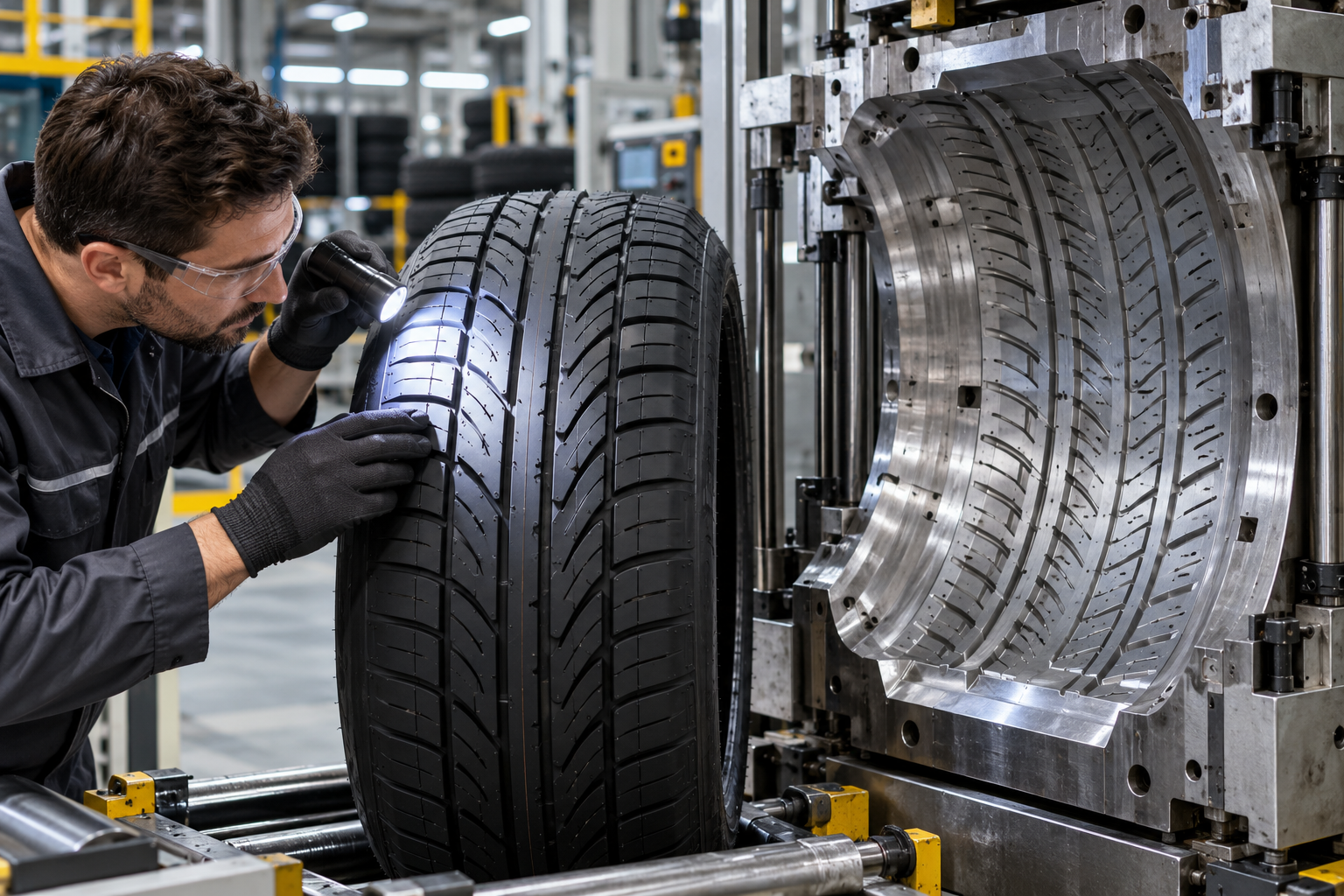
A rubber tire mold must form detailed tread geometry, sidewall markings and the final tire profile under repeated heat and pressure. When mold condition, venting or process settings become unstable, defects may appear on the cured tire.
Accurate troubleshooting starts by separating mold-related causes from rubber, press and operating-condition problems. This guide covers seven common defects and practical inspection points.
Regular mold cleaning and inspection can prevent many recurring defects. Read our Tire Mold Maintenance Guide for a complete maintenance checklist.
Table of Contents
1. Incomplete Tread Filling
Incomplete tread details often appear at narrow grooves, tread block corners or complex shoulder areas.
Possible causes include:
- Blocked vent holes
- Insufficient venting
- Contaminated mold cavities
- Incorrect curing pressure
- Poor rubber flow
- Low or uneven temperature
Begin by inspecting vents near the affected area. If the same defect repeatedly appears in one location, the rubber tire mold may require vent cleaning, vent modification or local cavity inspection.
2. Excessive Rubber Flash
Rubber flash can form around vents, segment joints, sidewall inserts and mold split lines.
Possible mold-related causes include:
- Oversized or worn vents
- Incorrect vent installation
- Damaged contact surfaces
- Contamination between components
- Segment misalignment
- Loose inserts
Measure the affected area and inspect the corresponding mold location. Do not remove material from the mold until the exact cause has been confirmed.
3. Visible Segment Joint Marks
Segment lines may become more visible when components are misaligned or when contact surfaces contain residue.
Inspect:
- Segment seating surfaces
- Guide components
- Container movement
- Local wear
- Foreign material between parts
- Matched segment identification
A rubber tire mold should close evenly around the complete circumference. Replacing one component without checking the entire assembly may not solve the problem.
4. Unclear Sidewall Lettering
Poorly formed letters or markings can reduce product appearance and create regulatory concerns.
Possible causes include contamination, damaged engraving, incorrect insert position, trapped air or insufficient cavity filling.
Remove and inspect replaceable inserts where applicable. Confirm that the characters are correctly oriented and fully seated.
If the engraving is worn, evaluate whether it can be repaired or whether the sidewall component requires replacement.
5. Difficult Tire Release
The cured tire should release without unnecessary damage to tread blocks or sidewall features.
Difficult demolding may result from:
- Damaged mold surfaces
- Contaminated cavities
- Incorrect surface condition
- Aggressive tread undercuts
- Segment movement problems
- Incorrect process timing
Inspect the exact area where the tire sticks. Repeated forceful removal can damage both the cured tire and the rubber tire mold.
Release problems caused by undercuts or complex tread geometry should be reviewed during the tire mold design stage.
6. Tire Surface Contamination
Stains, residue or uneven surface appearance may come from mold contamination, excessive lubricant, unsuitable cleaning chemicals or release-agent buildup.
Review recent maintenance activities and confirm that all cleaning materials are compatible with the mold.
The cavity should be completely clean and dry before production restarts. Lubricants must not enter tread or sidewall forming surfaces.
7. Dimensional Variation
Changes in tire dimensions can be related to mold temperature, curing pressure, component wear, incorrect assembly or unstable production settings.
Inspect critical rubber tire mold dimensions, including:
- Cavity profile
- Bead-ring position
- Radial runout
- Segment closure
- Sidewall alignment
- Mounting interfaces
Compare measurements with approved drawings and previous inspection records.
Dimensional accuracy also depends on controlling every stage of the tire mold manufacturing process.
A Practical Troubleshooting Method
Use this sequence when a defect appears:
- Record the defect location and frequency.
- Compare several tires from consecutive cycles.
- Identify the matching mold cavity position.
- Inspect vents, surfaces, inserts and joints.
- Check curing parameters and material conditions.
- Correct one verified cause at a time.
- Inspect the first tires after correction.
- Record the result.
Changing several settings at once can make the true cause difficult to identify.
Watch our rubber tire mold manufacturing, inspection and maintenance videos on our YouTube channel.
How to Prevent Repeated Defects
Preventive actions include regular cleaning, vent inspection, controlled assembly, maintenance records and scheduled dimensional checks.
Operators should report early changes in tire appearance instead of waiting for a serious quality problem.
A stable rubber tire mold should be supported by consistent curing conditions and a documented inspection process.
Frequently Asked Questions
Are all cured tire defects caused by the mold?
No. Rubber compound, bladder condition, temperature, pressure, timing and operator procedures can also contribute to defects.
Why does the same defect appear in one location?
A repeated local defect often indicates a blocked vent, damaged cavity feature, contaminated insert or alignment problem at the corresponding mold position.
Can damaged tread details be repaired?
Some damage can be repaired, but feasibility depends on location, material, depth and required accuracy.
When should a rubber tire mold be inspected?
Inspect it during scheduled maintenance and whenever repeated defects, difficult release or abnormal flash appears.
Solve Rubber Tire Mold Problems Earlier
Early inspection reduces scrap and production interruptions. Send defect photographs, tire samples and curing information to our engineering team for rubber tire mold analysis and repair recommendations.