
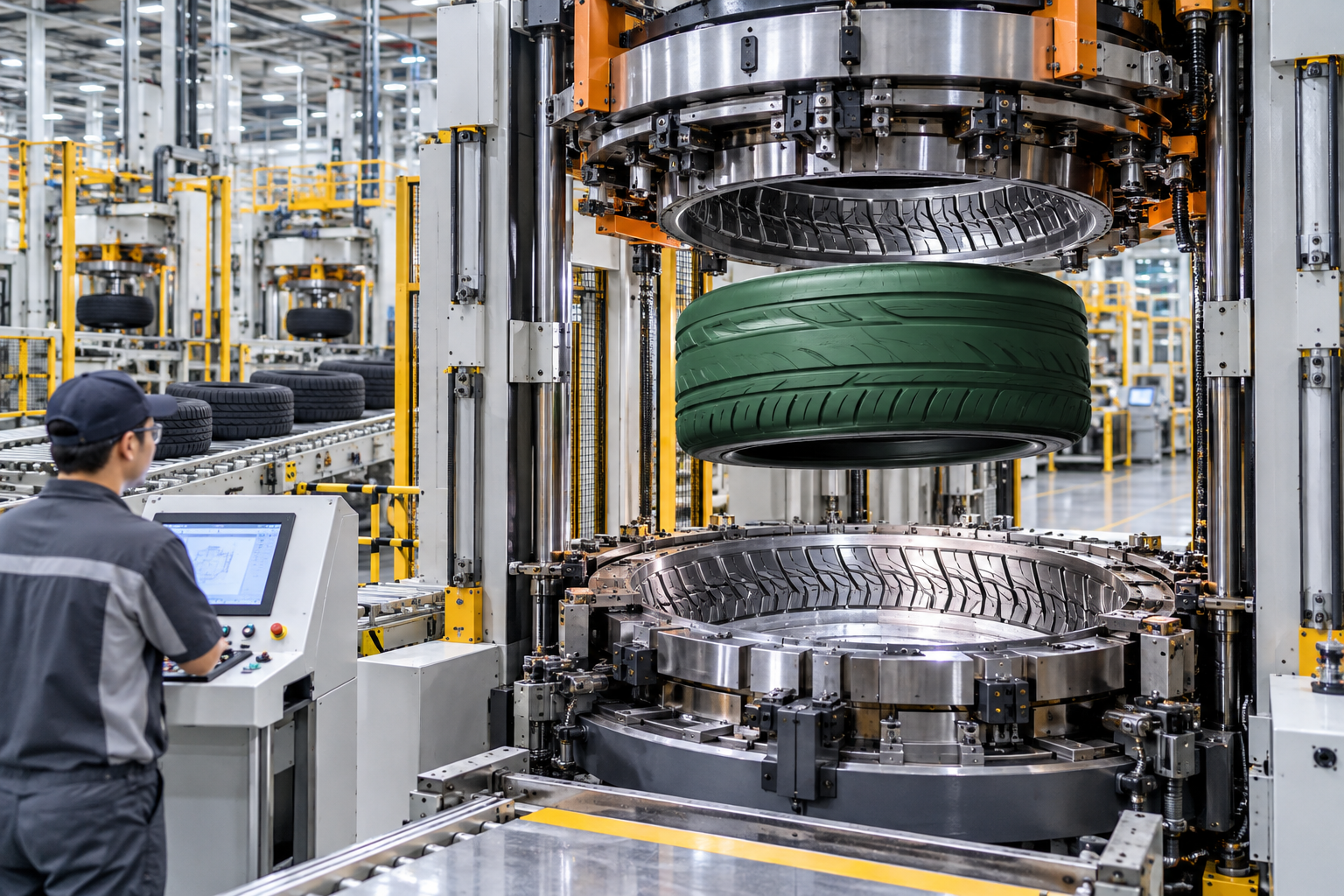
Stable tire molding requires the mold, curing press, bladder, rubber compound and operating parameters to work as one controlled system.
Even a high-quality mold cannot produce consistent tires when temperature, pressure, venting or equipment alignment changes between cycles. These nine improvement areas can help manufacturers reduce defects and stabilize production.
Tooling accuracy is also established during the tire mold manufacturing process, before the mold reaches the curing line.
Table of Contents
1. Control Incoming Green Tires
Consistent tire molding begins before the green tire enters the curing press.
Check green tire dimensions, component position, splice condition and surface contamination. Excessive variation at this stage can affect cavity filling and finished tire uniformity.
Green tires should be stored and handled under controlled conditions to prevent deformation before curing.
2. Stabilize Mold Temperature
The mold must reach and maintain the specified operating temperature.
Uneven temperature may contribute to inconsistent curing, surface variation and local dimensional changes. Heating passages, platens and temperature sensors should be inspected regularly.
Avoid restarting full production until the tire molding system has reached stable operating conditions.
3. Verify Curing Pressure
Internal pressure pushes the green tire against the mold cavity so the rubber can form tread, sidewall and bead details.
Insufficient or unstable pressure may cause incomplete filling. Abnormal pressure can also affect dimensions and curing consistency.
Pressure instruments should be calibrated, and unusual cycle data should be investigated before defects increase.
4. Maintain the Bladder
The bladder transfers pressure and heat to the inside of the tire. Its condition has a direct effect on tire molding.
Inspect for:
- Surface damage
- Local wear
- Incorrect expansion
- Leakage
- Contamination
- Installation errors
Follow the approved replacement schedule and record the number of cycles for each bladder.
5. Keep Mold Vents Clear
As the green tire expands, air must escape from the cavity. Blocked vents can create incomplete tread blocks, missing details and visible surface defects.
Inspect vents around complex tread features, shoulders and sidewall markings.
Vent cleaning should be included in the normal tire molding maintenance plan. Use tools that do not enlarge the vent holes or damage the mold surface.
Regular vent cleaning should be included in a planned Tire Mold Maintenance Program.
6. Confirm Mold and Press Alignment
Incorrect alignment can create uneven mold closure, excessive flash and inconsistent dimensions.
Check:
- Mold mounting surfaces
- Container position
- Segment movement
- Bead-ring location
- Press platens
- Guide components
- Fasteners
If defects consistently appear on one side of the tire, inspect press and mold alignment before changing unrelated process parameters.
Alignment and release requirements should also be evaluated during the original tire mold design stage.
7. Control Mold Cleanliness
Rubber residue, release agents and excessive lubricant can change the surface of the finished tire.
Clean the mold using an approved method that protects tread geometry and sidewall engraving.
After cleaning, confirm that the cavity is dry and that no debris remains between segments or inserts.
Cleanliness standards should be documented so different operators maintain the same tire molding conditions.
8. Monitor Every Curing Cycle
Important parameters should be recorded rather than checked only when a defect occurs.
Useful cycle data includes:
- Mold temperature
- Internal pressure
- Cure time
- Opening and closing time
- Alarm history
- Bladder cycle count
- Mold identification
- Operator or production line
Trend monitoring can reveal gradual changes before they cause significant scrap.
9. Inspect Finished Tires Systematically
Finished tire inspection connects production results with the tire molding process.
Inspect tread definition, sidewall markings, flash, surface appearance and dimensional characteristics. Record the position of every repeated defect so it can be matched with the corresponding mold location.
The first tires after a mold change, cleaning operation or repair should receive additional inspection.
A Simple Process-Improvement Method
When a recurring problem appears:
- Record the defect accurately.
- Identify when it started.
- Compare cycle parameters.
- Check the corresponding mold location.
- Inspect the bladder and press.
- Confirm green tire consistency.
- Change one verified factor.
- Inspect the result.
- Document the final solution.
Avoid changing temperature, pressure and cure time simultaneously. Multiple changes make the real cause difficult to identify.
Common Tire Molding Mistakes
Typical mistakes include:
- Starting production before temperatures stabilize
- Continuing after repeated pressure alarms
- Ignoring blocked vents
- Using damaged bladders
- Applying excessive release agent
- Failing to check mold alignment
- Mixing process settings between tire sizes
- Recording defects without their cavity positions
Frequently Asked Questions
What is tire molding?
Tire molding is the curing stage in which heat and pressure force a green tire against the mold cavity, forming the tread pattern, sidewall details and final tire shape.
What causes incomplete tread filling?
Possible causes include blocked vents, unstable pressure, low temperature, poor rubber flow or contamination in the mold cavity.
Why is cycle monitoring important?
Cycle monitoring helps identify gradual changes in temperature, pressure, timing and equipment behavior before they create repeated defects.
Can mold maintenance improve tire molding consistency?
Yes. Cleaning, vent inspection, alignment checks and component maintenance help the mold operate consistently across repeated curing cycles.
Watch our tire production, mold inspection and manufacturing videos on our YouTube channel.
Improve Your Tire Molding Process
Stable production depends on controlled tooling and curing conditions. Contact our technical team for mold evaluation, defect analysis and tire molding process support.